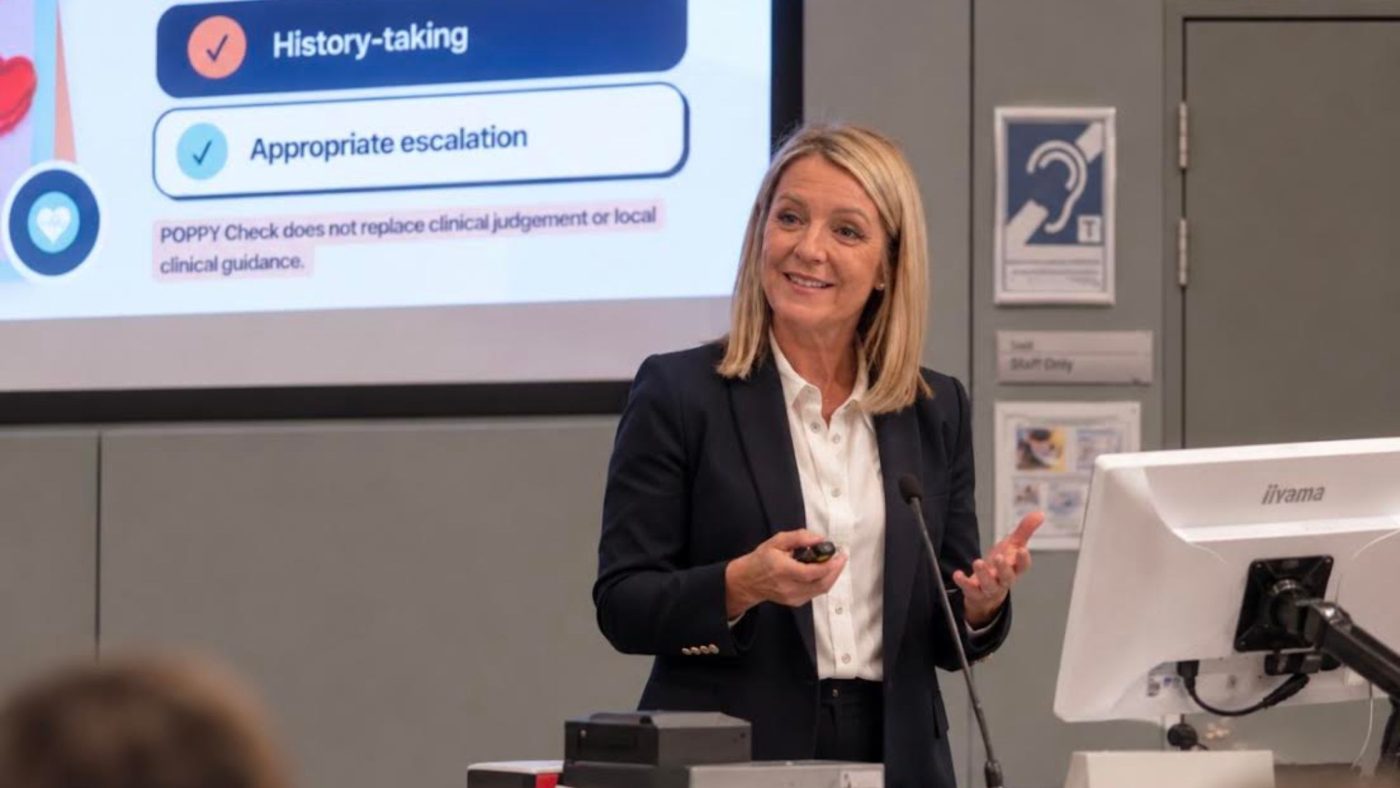
Why a normal resting ECG should never erase a concerning clinical history. “I'm not here to teach you cardiology. I'm here to ask you never to stop listening to the story.” This was the opening message from Poppy’s Light Foundation Founder Victoria Eagle at the University of Sunderland School of Medicine Cardiology Society Annual Conference, where medical students with an interest in cardiology came together to explore clinical innovation, specialist cardiac care and the importance of recognising cardiac warning signs.
For Poppy’s Light Foundation, the opportunity to contribute lived experience alongside specialist clinical education was particularly meaningful.
The Future of Cardiology: Innovation, Expertise and Clinical Curiosity
The conference brought together an impressive range of clinical expertise.
Dr Mickey Jachuck, Consultant Cardiologist and Clinical Director at South Tyneside and Sunderland NHS Foundation Trust, explored what cardiology might look like in 2036. From wearable technology to patient-generated health information, his presentation offered a fascinating perspective on how our NHS may continue to evolve towards more personalised and proactive care.
Mr Asif Raza Shah, Consultant Cardiothoracic and Transplant Surgeon at Newcastle’s Freeman Hospital, shared insights into complex cardiac surgery and the principles of heart and lung transplantation.
Brandon Ch’Ng explored cardiac amyloidosis and its association with carpal tunnel syndrome, highlighting how seemingly unrelated symptoms can sometimes provide important clues to underlying cardiac disease.
Together, the presentations demonstrated the extraordinary breadth of modern cardiology and the importance of recognising clinical patterns.
Exertional Syncope: When the Story Matters More Than a Reassuring Test
Poppy’s Light contributed a different perspective through Victoria’s presentation:
“A Normal Test Shouldn’t Erase an Abnormal Story: Recognising Red Flags in Inherited Cardiac Conditions.”
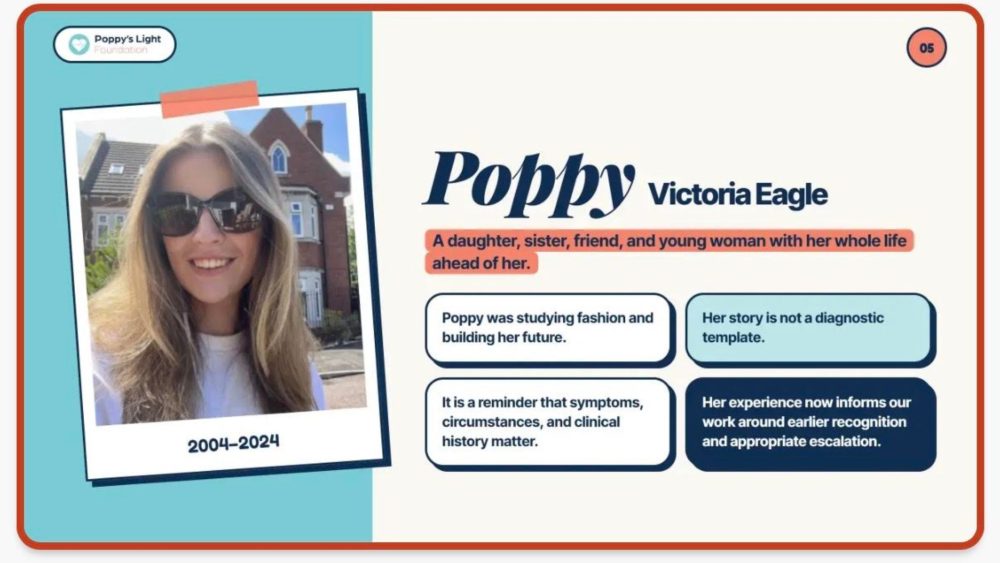
Poppy was a seemingly healthy 20-year-old young woman, studying fashion and building her future.
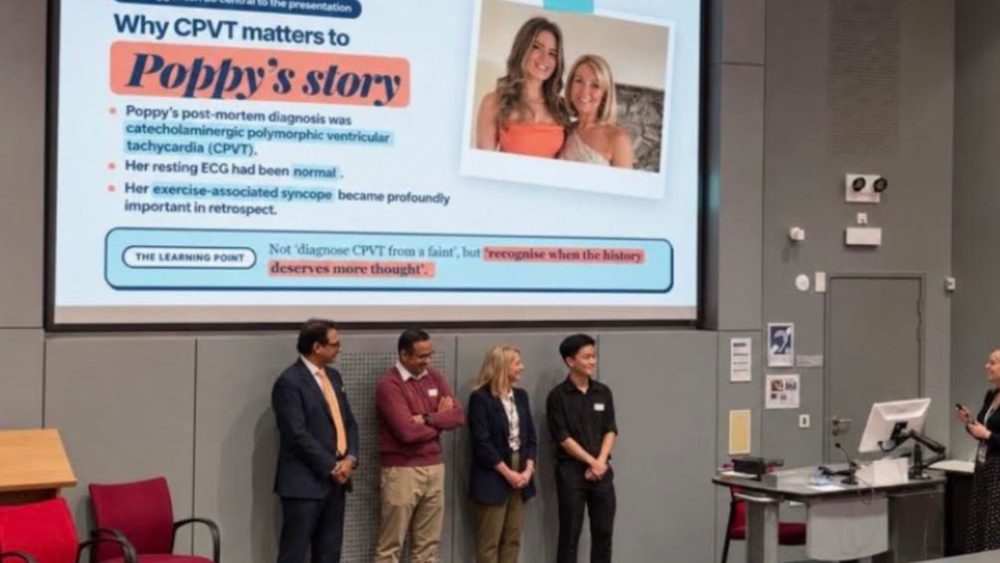
She had experienced exertional syncope, fainting associated with physical activity, and attended A&E, where her resting ECG was normal.
Following her sudden death in August 2024, post-mortem genetic investigation identified catecholaminergic polymorphic ventricular tachycardia (CPVT), an inherited arrhythmia condition that can cause dangerous heart rhythms during exercise or emotional stress.
Her story highlights a critical clinical distinction:
A normal resting ECG does not exclude every inherited cardiac condition.
In CPVT, potentially dangerous arrhythmias may be triggered by adrenaline and therefore may not appear on a resting ECG. Specialist assessment can include supervised exercise testing where clinically appropriate.
For medical students, the learning was not to diagnose CPVT from an episode of fainting, but to recognise when the circumstances and history warrant further investigation.
What happened immediately before the episode? Was there physical exertion or emotional stress? Were there palpitations, near-fainting or loss of consciousness? Is there a personal or family history of cardiac disease or sudden unexplained death?
The clinical history is data. And exertional syncope is a cardiac red flag that must not be overlooked.
Introducing the POPPY Check: Recognition, History-Taking and Escalation
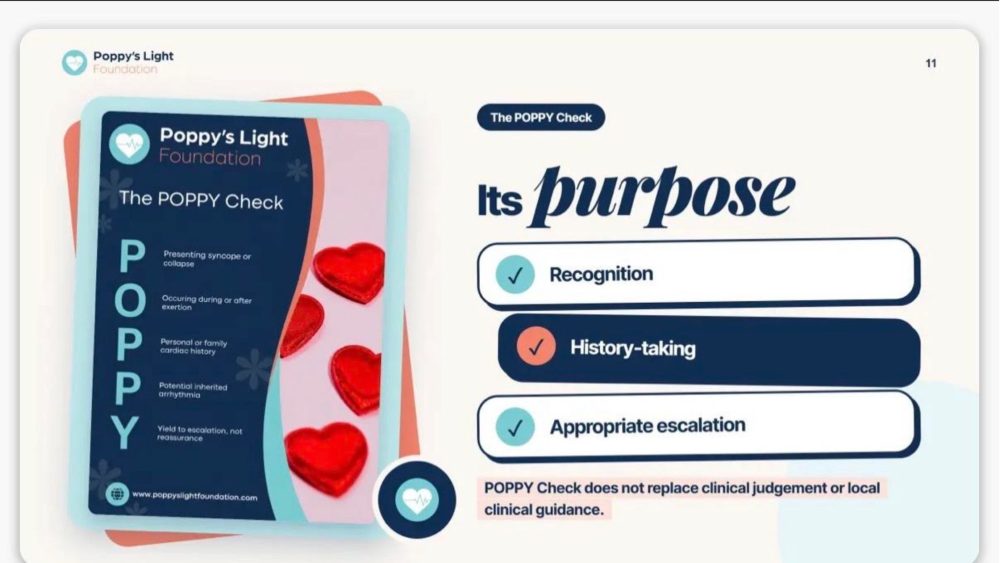
The conference also provided an opportunity to introduce the Foundation’s developing POPPY Check, a simple educational prompt supporting recognition of potential inherited cardiac conditions.
P — Presenting: Syncope or collapse
O — Occurring: During or after exertion
P — Personal: Personal or family cardiac history
P — Potential: Inherited arrhythmia
Y — Yield: To escalation, not reassurance
POPPY Check is not a diagnostic or screening tool. It is designed to complement clinical judgement and established referral pathways by encouraging careful history-taking and appropriate escalation when cardiac warning signs are identified.
Recognition is only the beginning. What matters next is timely access to the right level of specialist cardiac expertise.
From Poppy’s Story to Practical Clinical Learning
Through its three pillars Identify | Support | Live Poppy’s Light Foundation is working to improve awareness of inherited cardiac conditions, support earlier recognition and appropriate referral, and provide psychological and family support.
Contributing to the education of future doctors is an important part of that mission.
The Foundation extends its sincere thanks to the University of Sunderland Cardiology Society, the organising team and the specialist clinicians who generously shared their expertise.
The future of cardiology will be shaped by technology, research and increasingly sophisticated treatments. But careful history-taking, clinical curiosity and listening to patients and families will remain fundamental.
“If the test is normal but the story still feels abnormal, go back to the story.”
For Poppy.
And for the young person whose story you may hear next. 
Poppy’s Light Foundation | Identify. Support. Live.