Poppy’s Light Foundation’s inaugural Lunch & Learn brought clinical expertise and lived experience together with a shared ambition: earlier identification, established referral pathways, timely access to specialist expertise and long lives lived well.
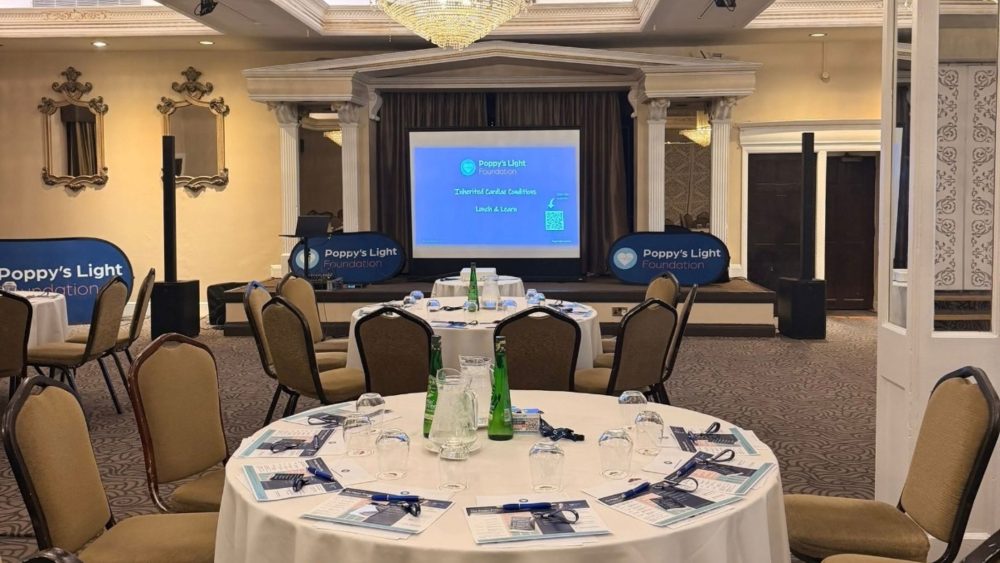
On Tuesday 29 September 2026, World Heart Day, Poppy’s Light Foundation welcomed healthcare professionals from across the North East to Ramside Hall for our inaugural Inherited Cardiac Conditions Lunch & Learn.
There could hardly have been a more fitting day.
Inherited cardiac conditions (ICCs) can affect children and young people who otherwise appear fit and well. Improving outcomes requires more than raising awareness. It requires recognising potential cardiac red flags, understanding when further investigation may be needed and having clear pathways into the right level of specialist expertise at the right time.
That was very much the spirit of our first Lunch & Learn.
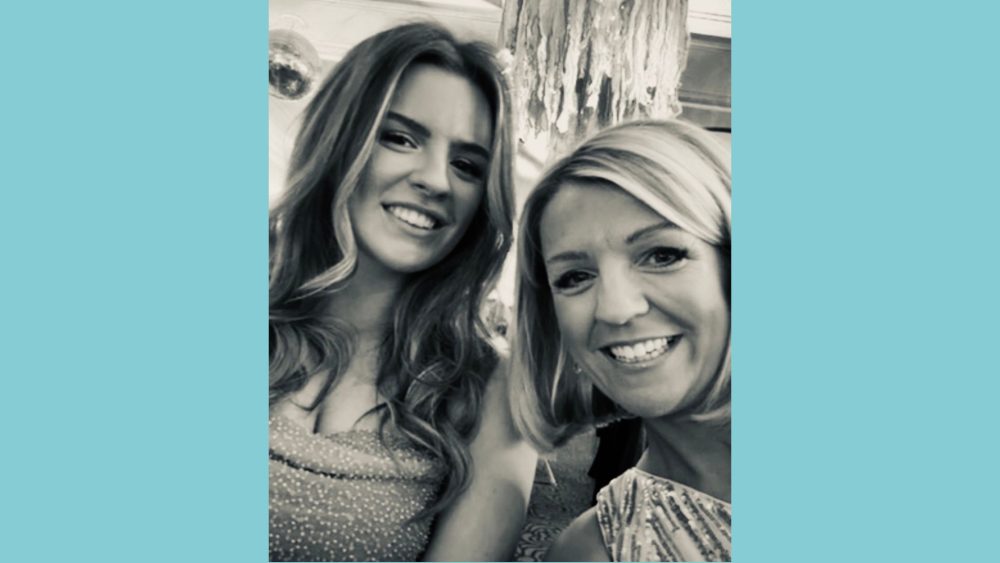
As Poppy’s mam, it was incredibly moving to look around a room filled with people willing to share their knowledge and experience in her name.
More than anything, though, the afternoon felt purposeful.
Leading cardiac expertise in one room
We were privileged to welcome some of our region’s leading cardiac expertise, including presentations from Dr Neil Seller, Dr Justina Rybicka and Dr Barbara Cardoso, alongside wider professional and lived-experience perspectives.
Together, we explored inherited cardiac conditions including inherited arrhythmias, cardiomyopathies and aortopathies, alongside the psychological and family impact that can accompany diagnosis.
The presentations were important, but so were the conversations around them.
Questions were asked. Experiences were shared. Connections were made between professionals who may encounter children, young people and families at very different stages of their journey.
That is exactly what we hoped our Lunch & Learn would create.
Because improving outcomes for young people with inherited cardiac conditions cannot sit with one clinician, one service or one charity.
It requires collaboration.
From recognising a red flag to accessing the right expertise
One of the strongest themes running through the afternoon was that identifying a potential cardiac problem is only the beginning.
Recognition needs to connect to established referral pathways.
When a young person presents with a concerning history or potential cardiac red flag, the person assessing them needs to know not only what might warrant further consideration, but also what happens next.
For inherited cardiac conditions, that may mean recognising when a presentation requires escalation beyond an initial assessment and ensuring there is a clear route to clinicians with appropriate specialist expertise.
That distinction is important.
Awareness without access is not enough.
Poppy died aged 20 from previously undiagnosed catecholaminergic polymorphic ventricular tachycardia (CPVT).
Before her death, she had experienced syncope, commonly referred to as fainting, associated with exercise and had attended A&E, where her resting ECG was normal.
Following Poppy’s death, genetic investigation identified CPVT.
Her experience is one of the reasons our work increasingly considers the whole journey:
Recognise. Escalate. Refer. Access the right expertise.
A reassuring initial investigation is valuable information, but it must always sit alongside the clinical history.
Or, as we increasingly describe it:
A normal test shouldn’t erase an abnormal story.
The developing POPPY Check
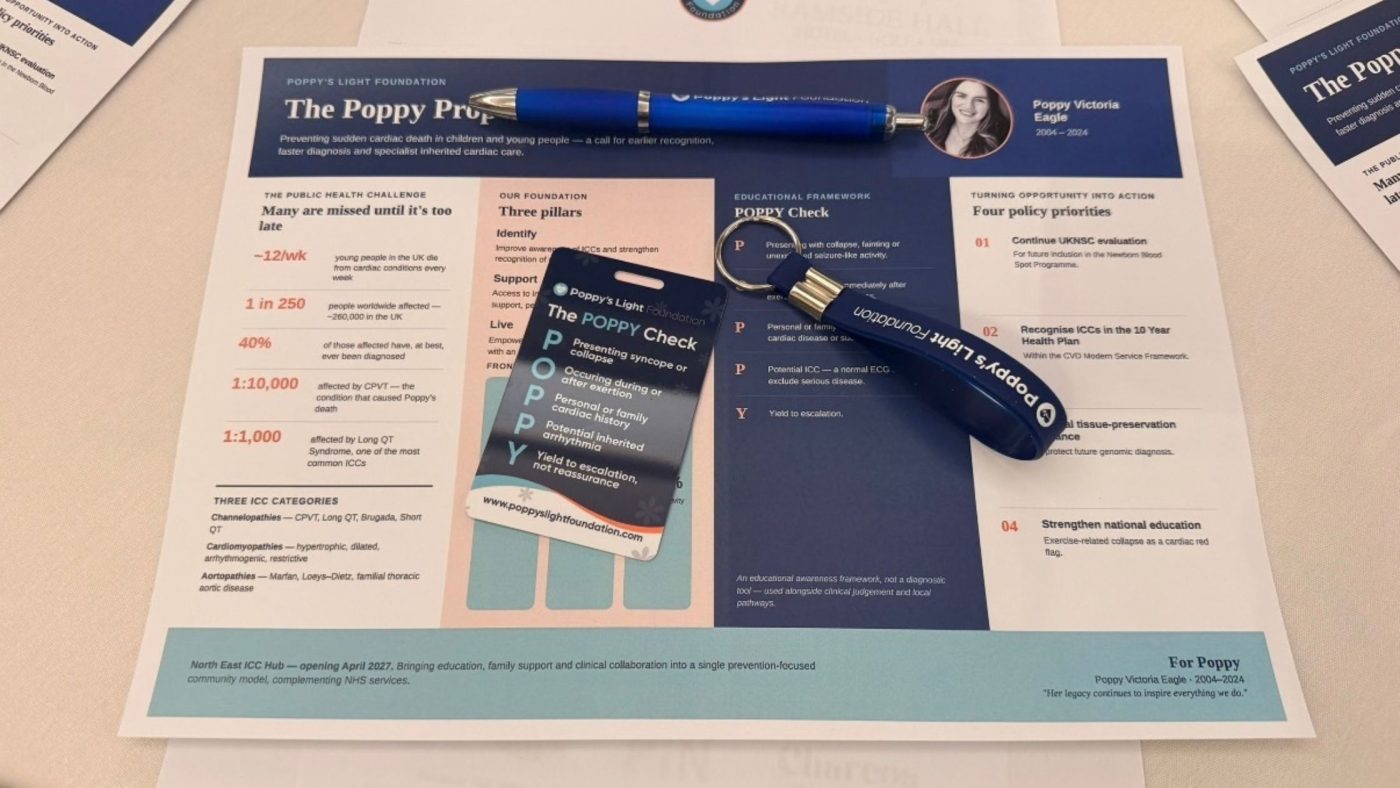
Our Lunch & Learn also provided an opportunity to share the developing POPPY Check, a simple recognition and escalation prompt informed by learning from Poppy’s experience:
P — Presenting syncope or collapse
O — Occurring during or after exertion
P — Personal or family cardiac history
P — Potential inherited arrhythmia
Y — Yield to escalation, not reassurance
The POPPY Check is not a diagnostic tool or screening test and does not replace clinical judgement.
Its purpose is to support recognition, good history-taking and appropriate escalation when a young person’s presenting story contains potential cardiac red flags.
And exertion does not necessarily mean competitive sport.
For a child or young person, it could be PE, swimming, dancing, climbing stairs quickly or simply running for a bus.
Likewise, young people may not use clinical language. They may describe fainting, dizziness, feeling lightheaded or feeling as though they were about to pass out.
Listening carefully to that story matters.
Three Connected Pillars
Identification is only one part of the journey.
An inherited cardiac condition diagnosis can affect an entire family. It may bring genetic testing and cascade screening, changes to sport or everyday life, uncertainty about the future and a significant psychological impact.
That is why Poppy’s Light is built around three connected pillars:
Identify | Support | Live
Identify improving education and recognition of cardiac red flags, alongside clear referral pathways and timely access to appropriate specialist expertise.
Support psychological, family and peer support for people affected by inherited cardiac conditions and sudden cardiac loss.
Live helping young people and their families live full lives following diagnosis.
Our ambition is not simply that an inherited cardiac condition is identified.
It is that a young person is identified, appropriately assessed, supported and enabled to live a long life, lived well.
Poppy’s Cardiac Health Hub: connecting recognition with access
The afternoon also gave us an opportunity to share our developing plans for Poppy’s Cardiac Health Hub, which we are working towards opening in April 2027.
Our ambition extends beyond identifying young people who may have an inherited cardiac condition.
We are exploring a prevention-focused neighbourhood model that can help connect recognition with established referral pathways and timely access to the right level of specialist cardiac expertise, while complementing existing NHS services.
The aim is not to create another layer of healthcare or duplicate the exceptional specialist expertise already available within our region.
It is to explore how the journey into and through that expertise can become clearer, more timely and better supported.
Alongside appropriate cardiac pathways, we want young people and their families to have access to psychological, family and peer support throughout their journey.
There is significant work still ahead. Clinical pathways, governance, workforce, regulation, funding and commissioning arrangements all need to be developed properly and collaboratively.
That is why events such as our Lunch & Learn matter.
They give us an opportunity not simply to present a model, but to listen to the people who understand the system and the patients it serves.
From grassroots recognition to specialist care
This ambition is also reflected in Poppy’s Proposal to the Secretary of State for Health and Social Care: a targeted, prevention-focused approach combining screening in grassroots settings, education across schools, colleges and universities, and neighbourhood health hubs providing established referral pathways and timely access to the right level of specialist cardiac expertise.
The principle connecting these different strands is straightforward.
A young person should not have to be a competitive athlete, already be known to cardiology or understand the language of inherited cardiac conditions for a potentially important history to be recognised.
Opportunities for recognition exist throughout everyday life, in families, schools, colleges, universities, grassroots sport, primary care and emergency healthcare.
But recognition must lead somewhere.
Education should support recognition.
Recognition should support appropriate escalation.
Escalation should connect to established pathways.
And pathways should lead to timely specialist expertise, treatment and support.
That is the continuum we want to help strengthen.
Collaboration, not duplication
There is already exceptional inherited cardiac expertise within the North East.
Poppy’s Light does not seek to replicate it.
Our role is to listen carefully to clinicians, young people and families; understand where gaps or barriers exist; and explore where charity, healthcare and wider community partners can work together to improve the journey.
Lived experience brings one perspective.
Clinical expertise brings another.
Neither should replace the other.
When they come together constructively, there is an opportunity to create something better.
From Poppy’s story to shared learning
Poppy’s Light Foundation exists because our beautiful daughter should still be here.
Poppy was 20.
She was studying fashion, discovering who she was, surrounded by people who loved her and building her future.
We cannot change what happened to Poppy.
But we can use what we have learned.
We can educate.
We can improve recognition of cardiac red flags.
We can encourage careful listening to the history behind an apparently reassuring test.
We can support clearer routes to specialist expertise.
We can support families.
And we can bring the right people together to ask:
What can we do differently for the next young person?
On Tuesday 29 September, World Heart Day 2026, seeing so much experience and expertise gathered in one room felt like an important step.
To Dr Neil Seller, Dr Justina Rybicka and Dr Barbara Cardoso, to every healthcare professional who joined us, and to everyone who contributed so openly to the afternoon thank you.
Our first Lunch & Learn gave us plenty to think about, plenty to build upon and an even stronger belief in the importance of collaboration.
Identify. Support. Live.
For Poppy and for long lives, lived well.